
Table of Contents
- The Animation Pipeline Overview
- Step 1: Concept and Story Development
- Step 2: Storyboarding and Animatics
- Step 3: Voice Recording
- Step 4: The 2D Animation Pipeline
- Step 5: The 3D Animation Pipeline
- Step 6: The Stop Motion Process
- Step 7: Compositing and Post-Production
- The Role of Each Department
- Timelines and Budgets
- Indie Animation Alternatives
- Key Takeaways
- Frequently Asked Questions
The Animation Pipeline Overview
If you have ever sat in a darkened theater watching characters fly across the screen and wondered how are animated movies made, you are not alone. The process behind creating an animated feature film is one of the most complex undertakings in all of entertainment. A single Pixar movie can take between four and seven years to complete, cost upwards of $200 million, and require the combined talents of 500 to 800 artists, engineers, and technicians working in concert.
At its core, every animated movie – whether it is a hand-drawn Disney classic, a computer-generated Pixar spectacle, or a painstaking stop motion production from Laika – follows a three-phase structure. Pre-production covers everything from the initial spark of an idea through screenplay development, visual design, storyboarding, and voice recording. Production is where the actual animation happens, along with modeling, rigging, texturing, lighting, and effects. Post-production handles compositing, color grading, sound design, musical scoring, and the final output for theaters or streaming platforms.
Understanding how animated movies are made gives you a deeper appreciation for the craft. Every frame you see on screen – and there are typically 24 frames per second, meaning a 90-minute film contains roughly 129,600 individual frames – has been carefully designed, reviewed, and refined by multiple specialists. Let us walk through every step of this remarkable process.
Step 1: Concept and Story Development
Every animated movie starts with an idea, and the journey from that initial concept to a finished screenplay is often the longest and most unpredictable phase of the entire production. At Pixar Animation Studios, filmmakers pitch ideas to the “brain trust,” a group of senior directors and writers who pressure-test every concept. Pete Docter pitched the idea for “Up” as a simple image – an old man’s house lifted by thousands of balloons – and that single visual concept eventually became a film that earned $735 million worldwide and won two Academy Awards.
Story development at major studios is an iterative and sometimes brutal process. Disney’s “Frozen” went through at least four complete story overhauls during its development cycle. The character of Elsa was originally conceived as a straightforward villain, the relationship between the two sisters was entirely different, and the famous song “Let It Go” was written so late in development that it fundamentally changed the direction of the entire film. Most animated screenplays go through 30 to 50 drafts before the story team is satisfied.
Alongside the writing, visual development artists – known in the industry as “vis dev” artists – create hundreds of concept paintings, character designs, and environmental sketches that establish the film’s look. These artworks define the color palette, architectural style, character proportions, and overall mood. For “Spider-Man: Into the Spider-Verse,” Sony’s vis dev team spent over a year experimenting with comic book halftone dots, Ben-Day printing patterns, and offset printing effects before arriving at the film’s groundbreaking visual language. This concept art becomes the visual bible that every department references throughout the production.
Step 2: Storyboarding and Animatics
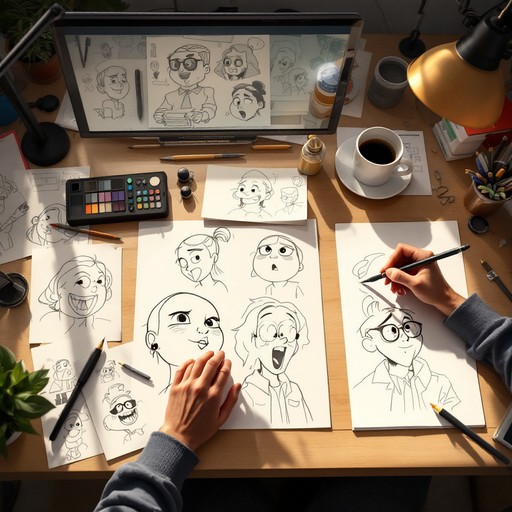
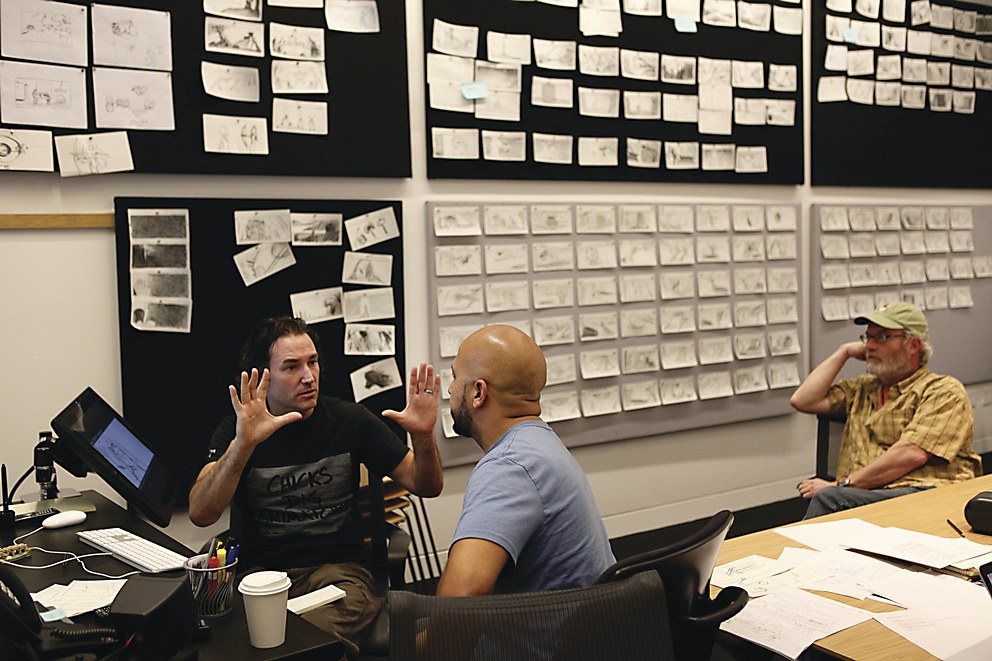
Storyboarding is where the film first takes visual shape. Story artists draw thousands of individual panels – essentially creating a comic book version of the entire movie – that map out every scene, camera angle, character position, and emotional beat. A typical feature-length animated film requires between 75,000 and 150,000 storyboard drawings over the course of production. At Pixar, story artists personally pitch their sequences to the rest of the team, standing in front of pinned-up panels and acting out the dialogue, sound effects, and physical comedy to sell each scene.
Once storyboard sequences are approved, they get assembled into an “animatic” – sometimes called a story reel. An animatic is essentially a rough video version of the movie, where storyboard drawings are timed to temporary voice recordings, placeholder sound effects, and scratch music. This is the first time anyone can sit down and watch the film from beginning to end, even though it looks nothing like the finished product. Animatics typically run 20 to 40 minutes longer than the final movie, and entire sequences get cut, reordered, or completely redrawn based on internal screening feedback.
The animatic phase is critical because it is far cheaper to fix story problems with simple drawings than with finished animation. Studios like DreamWorks and Illumination hold multiple internal screenings at this stage, often bringing in people from outside the production team to offer fresh perspectives on pacing, clarity, and emotional impact. Changes made during the animatic stage save millions of dollars compared to changes made during full production.
Step 3: Voice Recording
Unlike live-action filmmaking where actors perform on set and dialogue is captured simultaneously with the visual performance, animated movies record voice performances in a sound booth months or even years before animation begins. This sequence is essential because animators rely on the vocal performances to drive their character work. The timing, rhythm, emotion, and energy of an actor’s delivery directly shapes how a character moves, gestures, and expresses itself on screen.
Most major studios record actors individually in isolated sessions, though some directors prefer group recording for more natural chemistry. Brad Bird recorded significant portions of “The Incredibles” with the cast performing together in the same room, which helped capture the overlapping dialogue and natural interruptions of a real family. Voice recording sessions typically span two to three years on a major production, as the script evolves and new scenes are added while others are cut.
The sheer volume of recorded material can be staggering. Robin Williams improvised so extensively during the recording sessions for “Aladdin” that Disney accumulated over 16 hours of audio for the Genie character alone. Voice directors work with actors to capture dozens of variations of every line – different emotional reads, different pacing, different emphasis – giving the editorial team a rich palette of options to work with when assembling the final performance.
Step 4: The 2D Animation Pipeline
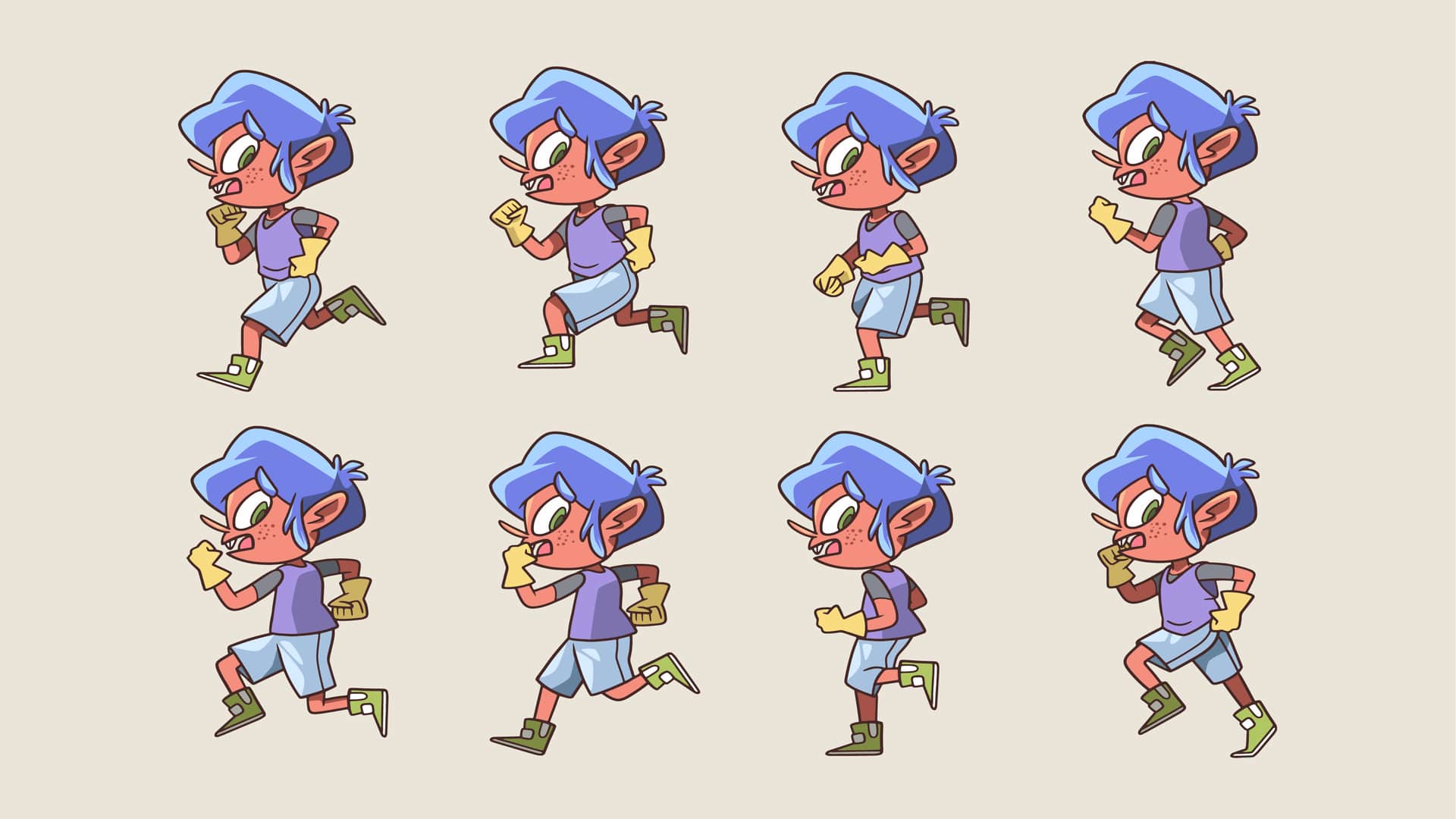
Traditional 2D animation – the method used to create classics like “The Lion King” (1994), “Beauty and the Beast,” and Studio Ghibli’s entire catalog – is built on the principle of drawing individual frames by hand. In a standard 2D pipeline, lead animators (called “key animators”) draw the most important poses in a character’s movement, known as “keyframes.” These keyframes define the start and end points of every action, as well as any critical in-between poses that establish the character’s personality and weight.
Once keyframes are completed and approved by the animation director, “in-between” artists (sometimes called “tweeners”) draw the frames that connect one keyframe to the next, creating the illusion of smooth motion. A fully animated film running at 24 frames per second on “ones” – meaning a new drawing for every single frame – requires approximately 129,600 individual drawings for a 90-minute film. Most 2D animation actually works on “twos,” where each drawing is held for two frames, cutting the total to around 64,800 drawings while still appearing smooth to the human eye.
Modern 2D animation often blends traditional hand-drawn techniques with digital tools. Studios like Cartoon Saloon (“Wolfwalkers,” “Song of the Sea”) use software such as Toon Boom Harmony and TVPaint to draw directly on digital tablets, which allows for easier corrections and more efficient coloring. The backgrounds in 2D films are typically painted separately – often as gorgeous standalone artworks – and the character animation is composited on top. Studio Ghibli’s background paintings, created by artists like Kazuo Oga, are considered some of the most beautiful artwork in the history of cinema.
Step 5: The 3D Animation Pipeline
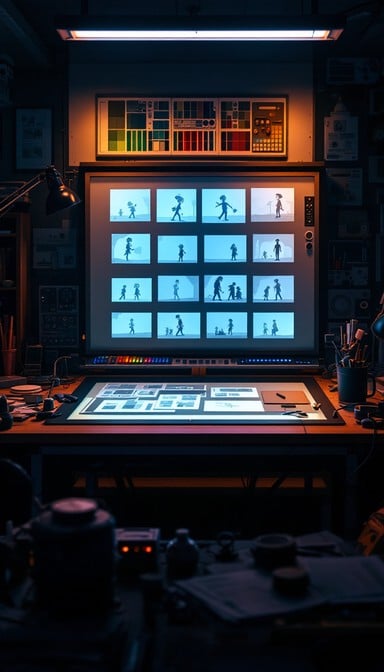
The 3D animation pipeline is where how animated movies are made gets truly technical. This pipeline has several distinct stages, each requiring specialized skills and software. The major stages are modeling, rigging, animation, texturing, lighting, effects, and rendering.
Modeling
3D modelers build every character, prop, vehicle, and environment in the film as a digital sculpture. Using software like Autodesk Maya, ZBrush, or Blender, modelers create geometry – networks of polygons that define the shape of every object. A single character model for a Pixar film can contain millions of polygons. The modeling team works from the concept art and character design sheets produced during pre-production, translating 2D drawings into fully three-dimensional forms that can be viewed from any angle.
Rigging
Once a character model is built, rigging technical directors create a digital skeleton inside it. This “rig” is a system of interconnected joints, controls, and constraints that allow animators to pose and move the character. A major character rig at a studio like Pixar or DreamWorks can have over 1,000 individual controls. Woody from “Toy Story 4” had over 800 facial controls alone, enabling animators to create incredibly subtle expressions. The quality of a rig directly determines how expressive and natural a character can be – a poorly built rig makes animation feel stiff and robotic, while a well-designed rig gives animators the freedom to create nuanced performances.
Animation
With rigged characters in hand, animators bring them to life. 3D animators work scene by scene, posing characters frame by frame using the rig controls. They set keyframes at critical moments in the action, and the software interpolates the movement between those keyframes. But unlike 2D animation where in-betweens are drawn by hand, 3D animators spend significant time adjusting the computer-generated in-betweens to ensure the motion feels natural and has proper weight, timing, and appeal. A single animator at Pixar typically produces between three and five seconds of finished animation per week on a feature film – a pace that reflects the extraordinary attention to detail involved.
Texturing and Shading
Texturing artists paint the surfaces of every 3D model, defining what each object looks like in terms of color, pattern, roughness, reflectivity, and transparency. They create texture maps – essentially flat images that wrap around the 3D geometry like wallpaper around a sphere. Shader technical directors then write mathematical descriptions (shaders) that tell the rendering software exactly how light interacts with each surface. The difference between a convincing material – say, the translucent skin on a character’s ear or the subtle peach fuzz on a baby’s cheek – and a fake-looking one often comes down to the quality of the shading work.
Lighting
Lighting artists place and adjust virtual lights throughout every shot in the film, controlling the mood, focus, and visual storytelling of each scene. Just like a cinematographer on a live-action set, lighting artists decide where shadows fall, how bright or dim an environment appears, and what color temperature the light carries. A single shot in a Pixar film might contain dozens of individual lights, each carefully positioned and tuned. The lighting team on “Coco” created more than 7 million individual lights across the film’s depiction of the Land of the Dead.
Rendering
Rendering is the computationally intensive process of converting all the 3D data – geometry, textures, lighting, effects – into final 2D images. This is where the computer calculates how every ray of light bounces through the scene, how shadows form, how reflections appear, and how atmospheric effects like fog or dust look. A single frame of a modern Pixar film can take 24 to 100 hours to render on a single processor. Studios use massive render farms – clusters of thousands of computers working in parallel – to process frames around the clock. Pixar’s render farm for “Lightyear” contained over 30,000 cores.
Step 6: The Stop Motion Process
Stop motion animation is the most tactile and physically demanding form of the craft. Studios like Laika (“Coraline,” “Kubo and the Two Strings”), Aardman (“Wallace and Gromit,” “Shaun the Sheep”), and the team behind Wes Anderson’s “Fantastic Mr. Fox” build real, physical puppets and sets, then photograph them one frame at a time, making tiny adjustments between each exposure.
The puppets themselves are engineering marvels. Laika creates metal armatures – internal skeletons with ball-and-socket joints – that allow precise, repeatable movement. Characters’ faces are often created using replacement animation, where hundreds or even thousands of 3D-printed face pieces are swapped between frames to create different expressions. For “Kubo and the Two Strings,” Laika 3D-printed over 23 million possible facial expressions for the title character using a modular system of interchangeable face components.
A skilled stop motion animator working on a feature film typically produces one to three seconds of finished footage per day. Sets are built at a scale that allows animators to reach every puppet, and the lighting must remain perfectly consistent across hundreds of exposures per scene. A single bump of the camera or a light accidentally shifted can ruin an entire day’s work. Despite these challenges, stop motion retains a handmade warmth and tactile quality that computer animation struggles to replicate.
Step 7: Compositing and Post-Production
Compositing is the final assembly stage where all the visual elements of each shot are combined into the finished image. Compositors layer together the character animation, backgrounds, effects (fire, water, smoke, dust particles), and any additional visual elements, adjusting color, contrast, and focus to create a cohesive final frame. They also add camera effects like depth of field, motion blur, lens flares, and film grain to give the digital imagery a more cinematic feel.
Color grading follows compositing, where colorists adjust the overall look of the film scene by scene to ensure visual consistency and enhance the emotional tone. A scene set during a warm sunset will be pushed toward golden and amber tones, while a tense nighttime sequence might be shifted toward cool blues and deep shadows. The colorist works closely with the film’s director and art director to ensure every shot matches the intended vision.
Sound design and music are equally critical post-production elements. Sound designers create and layer hundreds of individual sound effects for every scene – footsteps, cloth movement, ambient room tone, weather, and countless other details that make the animated world feel real. The musical score, composed specifically for the film, is recorded with a live orchestra and mixed with the dialogue and sound effects to create the final audio master. The complete sound mix for an animated feature can contain over 1,000 individual audio tracks.
The Role of Each Department
A major animated feature involves dozens of specialized departments, each with clearly defined responsibilities. The story department develops the screenplay and storyboards. The art department creates concept art, character designs, and color scripts. The modeling department builds 3D assets. The rigging department creates character controls. The animation department brings characters to life. The effects department simulates natural phenomena like water, fire, hair, and cloth. The lighting department illuminates every shot. The compositing department assembles final images. And the editorial department maintains the overall cut of the film, updating the animatic as finished shots replace storyboard panels.
Beyond these creative departments, there are also critical technical roles. Pipeline technical directors build and maintain the custom software tools that allow data to flow between departments. Render wranglers manage the render farm and troubleshoot failed frames. Production managers coordinate schedules, budgets, and deadlines across all departments. And quality control specialists review every finished shot to catch technical errors before they reach the final film.
The producer oversees the entire production from a business and organizational perspective, managing the budget and ensuring the project stays on track. The director holds the creative vision and makes final decisions on story, performance, and visual style. At many studios, the director works alongside a co-director or head of story who specifically manages the narrative side while the director focuses on visual execution.
Timelines and Budgets
The timeline for producing an animated feature varies enormously depending on the studio and the complexity of the project. Pixar films typically take four to seven years from initial concept to theatrical release. “Toy Story 4” was in development for roughly five years. Disney Animation operates on a similar timeline – “Moana” took approximately five years, and “Zootopia” required nearly the same. DreamWorks Animation tends to work slightly faster, with most films completing in three to five years.
Budgets have escalated dramatically over the decades. The original “Toy Story” in 1995 cost approximately $30 million. By 2010, major animated features routinely cost $150 million to $175 million. Today, the most ambitious productions regularly exceed $200 million. “Frozen 2” reportedly cost around $150 million in production alone, with marketing pushing the total investment past $250 million. “Lightyear” had an estimated production budget of $200 million. Even films from smaller studios like Laika operate on budgets of $60 million to $100 million, reflecting the labor-intensive nature of stop motion production.
These costs are driven primarily by labor. An animated feature at Pixar employs 500 to 800 people at peak production. Each of those artists, engineers, and managers works on the film for one to three years, making payroll by far the largest expense. Rendering costs are also significant – the computing power required to render a modern CG film can cost millions of dollars in electricity and hardware alone. Marketing and distribution add another $100 million to $150 million on top of the production budget for major worldwide releases.
Indie Animation Alternatives
Not every animated film requires a $200 million budget and a 700-person team. The indie animation scene has exploded over the past decade, thanks to increasingly powerful and affordable software tools. Blender, a free and open-source 3D animation suite, has become capable enough to produce professional-quality results. The feature film “Next Gen” (2018) was animated entirely in Blender. Toon Boom Harmony and OpenToonz (the software Studio Ghibli helped develop) provide professional 2D animation capabilities at a fraction of what custom studio pipelines cost.
Solo animators and small teams have produced remarkable work. Tomm Moore’s Cartoon Saloon operates with a team far smaller than any major Hollywood studio yet has earned four Academy Award nominations. Independent animator Nina Paley created the feature film “Sita Sings the Blues” almost entirely by herself over five years. More recently, animators on platforms like YouTube and Vimeo have built audiences of millions for independently produced short films and series, using consumer-grade hardware and software that would have been unimaginable a generation ago.
The barrier to entry for animated filmmaking has never been lower. A determined individual with a modern computer, a drawing tablet, and access to free or low-cost software can learn the fundamentals of animation through online courses and tutorials, then begin producing their own content. The quality gap between indie and studio animation remains significant for feature-length work, but for short films, music videos, and web series, independent creators are producing work that rivals anything coming out of major studios. Crowdfunding platforms like Kickstarter have also opened new financing paths, allowing independent animators to fund projects directly through their audiences.
Key Takeaways
- Animated movies follow a structured pipeline of pre-production, production, and post-production, with each phase involving dozens of specialized roles and departments.
- Major studio animated films like those from Pixar take four to seven years to produce and cost between $100 million and $250 million or more.
- The 3D animation pipeline includes modeling, rigging, animation, texturing, lighting, effects, and rendering – each requiring highly specialized skills.
- 2D animation relies on hand-drawn keyframes and in-betweens, with modern studios blending traditional techniques with digital tools like Toon Boom Harmony.
- Stop motion animation involves building physical puppets and sets and photographing them one frame at a time, with top animators producing just one to three seconds of footage per day.
- Indie animation has become increasingly viable thanks to free tools like Blender and affordable software, lowering the barrier to entry for independent filmmakers.
Frequently Asked Questions
How long does it take to make an animated movie?
Major studio animated films typically take three to seven years from initial concept to theatrical release. Pixar averages four to seven years per film. Smaller studios and independent productions can sometimes complete projects in two to three years with smaller teams, though the scope of the film is usually more limited. The longest phase is usually pre-production and story development, which can consume one to three years before full production even begins.
How much does it cost to make an animated movie?
Budgets range enormously. A major Pixar or Disney animated feature typically costs $150 million to $250 million in production alone, with marketing adding another $100 million or more. Mid-tier studio films from companies like Illumination or Sony Pictures Animation might cost $75 million to $150 million. Independent animated features can be made for $5 million to $30 million, and micro-budget indie projects have been completed for under $1 million, though these are rare exceptions that rely heavily on small teams working for reduced pay or deferred compensation.
What software is used to make animated movies?
The most widely used 3D animation software in the industry is Autodesk Maya, which is the primary tool at Pixar, Disney, DreamWorks, and most major studios. ZBrush is standard for sculpting detailed character models. Houdini is used extensively for visual effects like water, fire, and destruction. For 2D animation, Toon Boom Harmony is the industry leader, followed by TVPaint and Adobe Animate. Blender, which is completely free, has gained significant industry traction and is now used on professional feature film and television productions.
Can one person make an animated movie?
It is technically possible but extremely challenging. Solo animators like Nina Paley (“Sita Sings the Blues”) and Makoto Shinkai (whose early short films were one-person productions) have demonstrated that a single determined individual can create feature-length or short animated works. However, the time investment is enormous – often five years or more for a feature – and the scope must be carefully managed. Most independent animated features involve at least a small core team of five to twenty people, even when one person serves as the primary creative force.
What is the difference between 2D and 3D animation?
2D animation creates the illusion of movement through sequences of flat drawings or digital illustrations, with characters and environments rendered from specific planned angles. 3D animation builds fully three-dimensional digital models that exist in virtual space and can be viewed and animated from any angle, similar to puppets on a virtual stage. Each approach has distinct strengths – 2D offers a handcrafted artistic quality and more stylistic freedom, while 3D provides depth, realistic lighting, and camera flexibility. Many modern productions blend both techniques, as seen in “Spider-Man: Into the Spider-Verse.”