
Table of Contents
- What Copyright Actually Protects in Music
- Automatic Copyright vs. Registration
- Why You Should Register Your Copyright
- Step-by-Step Registration with the US Copyright Office
- Costs, Fees, and Timeline
- What You Cannot Copyright in Music
- Copyright vs. Publishing: Understanding the Difference
- Protecting Your Rights After Registration
- International Copyright Protection
- Key Takeaways
- Frequently Asked Questions
What Copyright Actually Protects in Music
Before learning how to copyright a song, you need to understand what copyright actually covers – and what it does not. Copyright is a form of legal protection that gives creators exclusive rights over their original creative works. In music, there are actually two separate copyrights for every song.
The first is the composition copyright (also called the “publishing” copyright). This covers the underlying musical composition – the melody, harmony, chord progression, lyrics, and arrangement that make up the song itself. Whether the song is written on a napkin, recorded in a studio, or performed live, the composition copyright protects the musical and lyrical content. This copyright typically belongs to the songwriter or songwriters (or their publisher if they have signed a publishing deal).
The second is the sound recording copyright (also called the “master” copyright). This covers the specific recorded version of the song – the actual audio file with all its production, vocal performances, instrumental performances, and mixing/mastering choices. Two different bands could record the same song, and each recording would have its own separate sound recording copyright. This copyright typically belongs to the artist or the record label (if the recording was made under a label deal).
Understanding this distinction is essential for anyone learning how to copyright a song, because you may need to register both copyrights separately depending on your situation. If you are a songwriter who wrote a song but did not record it, you are protecting the composition. If you are an artist who wrote and recorded a song, you are protecting both the composition and the sound recording.
Automatic Copyright vs. Registration
Here is something that surprises many people learning how to copyright a song: your song is actually copyrighted the moment you create it in a tangible form. Under US copyright law (and the laws of most countries that signed the Berne Convention), copyright protection automatically attaches to an original creative work as soon as it is “fixed in a tangible medium of expression.” That means the moment you write down your lyrics, record a voice memo of your melody, or save a DAW project file, your song is technically copyrighted.
So why bother with registration at all? Because automatic copyright gives you ownership, but registration gives you enforcement power. Without registration, your ability to protect your rights in court is severely limited. This is the critical distinction that makes formal registration so important.
Why You Should Register Your Copyright
Registration with the US Copyright Office provides several crucial legal advantages that automatic copyright alone does not.
Right to Sue for Infringement
In the United States, you cannot file a copyright infringement lawsuit until your work is registered (or your registration application has been filed). If someone steals your song and you have not registered, you first have to file for registration and wait for it to be processed before you can take legal action. During that delay, the infringer continues profiting from your work.
Statutory Damages and Attorney’s Fees
If your copyright was registered before the infringement occurred (or within three months of publication), you are eligible for statutory damages of $750 to $30,000 per infringement (up to $150,000 for willful infringement) and recovery of attorney’s fees. Without timely registration, you are limited to “actual damages” – the provable financial harm you suffered – which can be difficult and expensive to demonstrate in court. This is the single most important reason to learn how to copyright a song and actually do it promptly.
Public Record
Registration creates a public record of your claim, which can be valuable evidence in disputes. The registration certificate is considered prima facie evidence of copyright ownership if the work was registered within five years of publication. This means the burden of proof shifts to the other party to disprove your ownership.
Protection Against Imports
A registered copyright can be recorded with US Customs and Border Protection to prevent the importation of infringing copies of your work. While this is more relevant for physical products, it provides an additional layer of protection.
Step-by-Step Registration with the US Copyright Office
Here is the practical process of how to copyright a song through the US Copyright Office. The entire process can be completed online.
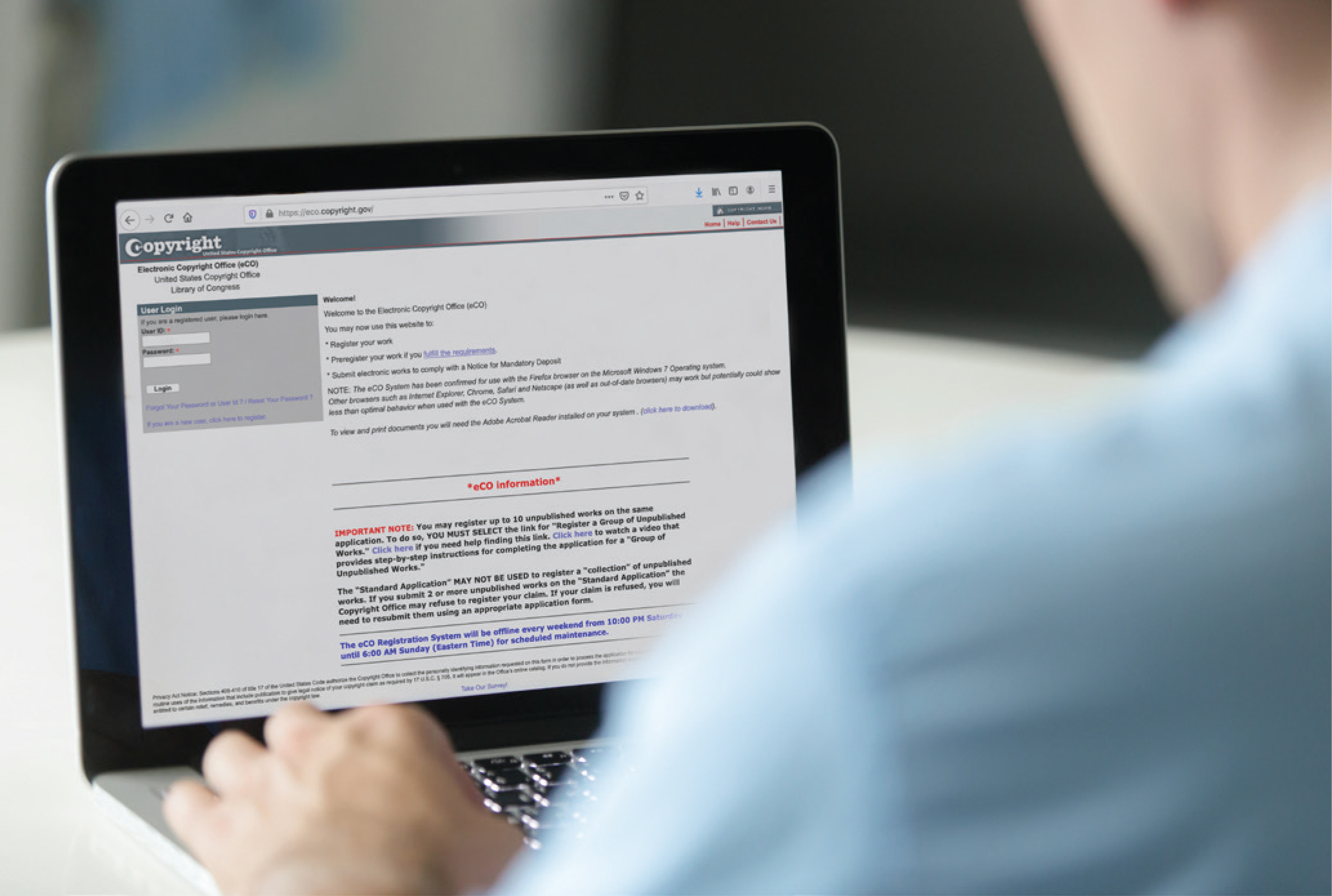
Step 1: Create an Account on copyright.gov
Go to copyright.gov and create a free account on the Electronic Copyright Office (eCO) system. You will need a valid email address and basic contact information. The account creation takes about five minutes.
Step 2: Start a New Registration
Log in and click “Register a Work.” You will be asked to select the type of work. For a song with both lyrics and music, select “Work of the Performing Arts.” If you are registering a sound recording (the recorded version), select “Sound Recording.” If you want to register both the composition and the sound recording in a single application (which is possible if the same party owns both), you can do so by selecting “Sound Recording” and checking the option to include the underlying musical composition.
Step 3: Complete the Application
The application asks for several pieces of information. The title of the work – your song’s title. The year of creation – when the song was first written or recorded. The date of first publication – if the song has been released (distributed to the public), enter the date. If it has not been published, leave this blank. The author information – the names of the songwriters and, if applicable, the performers of the sound recording. The claimant – the person or entity claiming copyright ownership (usually you).
Step 4: Upload Your Deposit Copy
You must submit a “deposit copy” of your work – the actual song. For unpublished works, upload one copy. For published works, upload two copies. Acceptable formats include MP3, WAV, FLAC, and other standard audio formats for sound recordings. For compositions only, you can submit a PDF of the sheet music or lyrics. The upload system has a file size limit, so an MP3 file is typically the most practical choice for audio submissions.
Step 5: Pay the Filing Fee
Pay the registration fee by credit card, debit card, or deposit account. Once payment is processed, your application is submitted. You will receive a confirmation email with your case number, which serves as proof that your application has been filed.
Step 6: Wait for Processing
The Copyright Office reviews your application and, if everything is in order, issues a certificate of registration. The certificate includes the registration number and the effective date of registration (the date your complete application was received, not the date the certificate is issued).
Costs, Fees, and Timeline
Understanding the financial and time investment is an important part of learning how to copyright a song.
Registration Fees
A single work by a single author filed online costs $65 (as of 2026). A “Standard Application” (for works with multiple authors, works made for hire, or group registrations) costs $65 as well. You can register a group of up to 10 unpublished songs in a single application for $65 – this is the most cost-effective approach if you have multiple songs ready. Paper applications cost $125 but are rarely used in 2026 since online filing is faster and cheaper.
Processing Time
As of 2026, the US Copyright Office processes online applications in approximately 3 to 8 months. Paper applications take 8 to 14 months. However – and this is important – the effective date of your registration is the date the Copyright Office receives your complete application (not the date they finish processing it). So your protection begins when you submit, even if the certificate arrives months later.
Expedited Processing
If you need faster processing (for example, if you need a registration to file a lawsuit), you can request Special Handling for an additional fee of $800. Special Handling can reduce processing time to a few weeks. This is expensive but sometimes necessary in urgent infringement situations.
What You Cannot Copyright in Music
Understanding the limitations of copyright is just as important as knowing how to copyright a song.
Chord Progressions
You cannot copyright a chord progression. The I-V-vi-IV progression is used in thousands of songs, and no one owns it. Chord progressions are considered too basic and common to qualify for copyright protection. If they were copyrightable, virtually every songwriter would owe money to someone else.
Song Titles
Song titles cannot be copyrighted. That is why there are multiple songs called “Stay,” “Love,” “Home,” and dozens of other common titles. Titles are considered too short to contain sufficient creative expression for copyright protection. However, a song title could potentially be trademarked if it has strong brand recognition.
Genre Conventions and Musical Styles
You cannot copyright a genre, a rhythmic pattern, a tempo, or a general musical style. A trap hi-hat pattern, a boom-bap drum feel, or a four-on-the-floor kick pattern are all common musical elements that anyone can use freely.
Ideas and Concepts
Copyright protects expression, not ideas. You cannot copyright the idea of a love song, a breakup anthem, or a party track. You can only copyright your specific expression of that idea – your particular melody, your particular lyrics, your particular arrangement.
Copyright vs. Publishing: Understanding the Difference
Many songwriters confuse copyright registration with music publishing. They are related but distinct concepts, and understanding both is important when learning how to copyright a song.
Copyright
Copyright is the legal ownership right. When you copyright your song, you own the legal right to reproduce, distribute, perform, and create derivative works from your composition. Copyright registration with the US Copyright Office confirms and strengthens this right.
Publishing
Music publishing is the business of monetizing your copyrighted songs. A music publisher (or you, if you self-publish) handles licensing your songs for use in recordings, films, TV shows, commercials, and live performances, and collects the royalties generated from those uses. Registering with a Performing Rights Organization (PRO) like ASCAP, BMI, or SESAC is how you collect performance royalties when your song is played on radio, streamed, or performed live. This is separate from copyright registration but equally important for earning money from your music.
The Recommended Approach
For complete protection and monetization, a songwriter should register their copyright with the US Copyright Office (legal protection), register as a songwriter with a PRO – ASCAP or BMI (performance royalty collection), and register their songs with their PRO (so royalties are tracked and paid). If you also own the publishing rights (which you do by default unless you have signed them away), register as your own publisher with the same PRO.
Protecting Your Rights After Registration
Registration is only valuable if you enforce your rights when they are violated. Here is how to protect your copyrighted music.
Monitor for Infringement
Use tools like YouTube’s Content ID (if you distribute through a service that enrolls your music), Shazam, and manual searches to monitor whether your song is being used without permission. Services like DistroKid and CD Baby can register your music with Content ID on your behalf, which automatically detects unauthorized uses of your recordings on YouTube.
Cease and Desist Letters
If you discover unauthorized use of your song, the first step is typically a cease and desist letter. This is a formal letter demanding that the infringer stop using your work and, depending on the situation, pay licensing fees or damages. Many infringement cases are resolved at this stage without going to court. An entertainment attorney can draft this letter for $200-$500, or you can find templates online for simple cases.
DMCA Takedown Notices
If your song appears without authorization on platforms like YouTube, Spotify, SoundCloud, or social media, you can file a DMCA (Digital Millennium Copyright Act) takedown notice. Each platform has its own process for filing takedowns, usually accessible through their help or legal pages. Platforms are required by law to remove infringing content promptly after receiving a valid DMCA notice.
Litigation
For serious infringement cases involving significant financial stakes, litigation may be necessary. This is where copyright registration becomes crucial – without it, you cannot file a federal lawsuit. Copyright litigation is complex and expensive (attorney fees can run $50,000-$500,000+), so it is typically reserved for cases involving substantial damages. If you registered your copyright before the infringement (or within three months of publication), your ability to recover statutory damages and attorney’s fees makes litigation far more financially viable.
International Copyright Protection
Music is consumed globally, so understanding how to copyright a song beyond US borders matters.
The Berne Convention
The United States is a member of the Berne Convention, an international treaty that provides copyright protection across over 180 countries. Under the Berne Convention, a copyright created in one member country is automatically recognized in all other member countries. This means your US copyright registration provides a basis for protection worldwide, though enforcement procedures vary by country.
No International Registration System
There is no single “world copyright” registration system. Each country has its own copyright office and registration process. However, because the Berne Convention provides automatic protection, most songwriters only need to register in their home country. If you have specific concerns about infringement in another country, consult an intellectual property attorney who specializes in international copyright.
WIPO and International Treaties
The World Intellectual Property Organization (WIPO) administers several international copyright treaties that strengthen protection across borders. The WIPO Copyright Treaty and the WIPO Performances and Phonograms Treaty provide additional protections for digital distribution and online use. These treaties ensure that your song is protected when streamed, downloaded, or shared internationally.
Key Takeaways
- Every song has two copyrights – the composition (melody and lyrics) and the sound recording (the specific recorded version)
- Copyright is automatic upon creation, but registration with the US Copyright Office is essential for full legal protection
- Registration costs $65 online and allows you to sue for infringement, recover statutory damages, and claim attorney’s fees
- You can register up to 10 unpublished songs in a single application for $65 – the most cost-effective approach
- Chord progressions, song titles, and musical styles cannot be copyrighted – only specific melodies, lyrics, and arrangements
- Also register with a PRO (ASCAP or BMI) to collect performance royalties – this is separate from copyright registration
- The Berne Convention provides automatic copyright protection across 180+ countries for US-registered works
Frequently Asked Questions
Can I just mail myself a copy of my song to prove I wrote it?
This is known as the “poor man’s copyright,” and it is essentially worthless in court. Mailing yourself a sealed envelope with your song inside does not establish a legal copyright and is not accepted as evidence in federal copyright infringement cases. The only way to secure the full legal protections discussed in this article – the right to sue, statutory damages, and attorney’s fees – is through formal registration with the US Copyright Office. At $65 for up to 10 songs, proper registration is affordable and infinitely more protective.
Do I need to copyright my song before posting it on Spotify or YouTube?
Your song is automatically copyrighted the moment you create it, so posting it online does not put you in immediate legal danger. However, registering before or shortly after publication is strongly recommended. If your song goes viral and someone copies it, you will want the enforcement tools that registration provides. The safest approach is to register your copyright before releasing music publicly. At minimum, register within three months of publication to preserve your eligibility for statutory damages.
If I co-wrote a song, who owns the copyright?
Under US law, co-writers are automatically considered joint authors who share equal ownership of the copyright unless they have a written agreement stating otherwise. This means each co-writer owns an equal share (50/50 for two writers, 33/33/33 for three, etc.) and each has the right to license the song – though they must share revenue with the other co-writers. It is critical to create a written split sheet that documents each writer’s percentage before or immediately after the writing session. Disputes over ownership splits are among the most common legal conflicts in the music industry.
How long does a music copyright last?
For songs created after January 1, 1978, copyright lasts for the life of the author plus 70 years. For works made for hire (where the copyright belongs to a company rather than an individual) and anonymous works, copyright lasts 95 years from publication or 120 years from creation, whichever is shorter. After the copyright expires, the song enters the public domain and can be used freely by anyone. This is why very old songs like “Happy Birthday” are now free to use, while songs from the last several decades remain protected.
Does copyright registration protect my song title?
No. Copyright does not protect song titles, short phrases, or slogans. If you want to protect a song title as a brand identifier (for merchandise, a podcast name, or a franchise), you would need to pursue trademark registration through the US Patent and Trademark Office, which is a separate legal process. However, trademark protection for song titles is rare and typically only applicable when the title has acquired significant commercial recognition beyond the song itself.