How the Shift From Physical to Digital Changed Nigerian Music Revenue Forever
Tristan Melo··11 min read
Ad SpaceArticle Top - 728x90
Advertisement
Walk through Alaba International Market in Ojo, Lagos around 2005 and the soundtrack hit you before the sights did. Stalls stacked with CDs and cassettes blasted Tony Tetuila, Plantashun Boiz, and 2Face at competing volumes, each vendor convinced his speakers were the loudest. The discs sold for a couple of hundred naira at most. The artists whose faces were printed on the covers saw almost none of that money. Two decades later, a Burna Boy single can rack up tens of millions of plays across the major streaming platforms, and the cheques actually reach his account. The road between those two realities is the entire modern history of Nigerian music economics.
The Alaba Era: When Pirates Ran the Industry
For most of the 1990s and 2000s, Alaba Market functioned as both the largest distribution hub for Nigerian music and the largest pirate operation against it. Industry estimates from the period routinely placed Nigeria’s music piracy rate at 70 to 80 percent, meaning for every legitimate copy sold, at least three or four bootleg duplicates moved through the same market. The Nigerian Copyright Commission ran periodic raids. Stalls shut for a week, then reopened. Nothing structural changed.
The economic model that survived inside that environment was brutal in its simplicity. An artist who finished an album would walk into a distributor’s office, usually somewhere in Alaba or Idumota, and accept a single upfront payment for the master. Reported figures from that era ranged from a few hundred thousand naira for unknowns to a few million for established acts. After that handshake, the artist saw nothing more. Every unit sold, legitimate or pirated, flowed back to the distributor and the network of marketers under him. The artist’s only remaining revenue stream was live performance and whatever radio play could be converted into bookings.
PMAN, COSON, and the Royalty Wilderness
The Performing Musicians Employers’ Association of Nigeria, known as PMAN and formed in 1981, spent decades trying to organise this chaos. PMAN’s leadership rotated through high-profile musicians, fought public battles over membership dues, and held press conferences about piracy. It produced more headlines than royalty cheques. By the late 2000s, the organisation had splintered into factions and lost most of its operational credibility within the industry.
The Copyright Society of Nigeria, known as COSON, took up the royalty collection mantle in 2010 after being approved by the Nigerian Copyright Commission. Under chairman Tony Okoroji, COSON began collecting from broadcasters, hotels, and event venues, and for several years it distributed real money to members. Then came the legal disputes, the leadership crisis, and regulatory action against its operating approval, and royalty collection in Nigeria fractured again. The lesson the industry absorbed was uncomfortable: waiting for a collection society to fix the revenue problem was not a strategy any individual artist could afford.
The First Digital Wave: Caller Tones and Carrier Platforms
Before streaming arrived as it is understood today, the first real digital revenue breakthrough for Nigerian artists came from an unlikely source. Caller ring back tones, sold through MTN, Glo, Airtel, and Etisalat between roughly 2008 and 2014, generated more revenue for some Nigerian artists than CD sales ever had. A subscriber paid a small monthly fee, deducted straight from airtime, to have a snippet of a song play when someone called their line. Multiplied across millions of subscribers on networks that were adding users faster than any other sector of the Nigerian economy, the cumulative cheques became significant for the first time in the industry’s history.
The records that dominated the ringback charts of that period, among them D’banj’s “Oliver Twist”, the P-Square catalogue, and KCee’s “Limpopo”, are widely credited with generating substantial ringback revenue, though the splits between telco, aggregator, label, and artist were never published and the totals that circulate are estimates rather than disclosed figures. What mattered structurally was the format itself. For the first time, a digital product was producing income that could be counted, invoiced, and chased, and the ringback era quietly funded a generation of Afrobeats producers and labels.
MTN Music+, Spinlet, iROKING
The early 2010s also produced a wave of dedicated Nigerian and pan-African music platforms attempting to build Spotify-style services before Spotify was available. MTN Music+ launched in the mid-2010s as a subscription streaming and download service. Spinlet, founded earlier, pitched itself as the African iTunes. iROKING, the music arm of the Iroko Partners group behind iROKOtv, signed catalogue deals with hundreds of Nigerian artists. None of them achieved escape velocity. Smartphone penetration was still climbing, data costs were punishing, and the user habit of paying a monthly fee for music had not yet formed in the market. By the late 2010s, all three had either folded, pivoted, or shrunk to the point of irrelevance. What they did accomplish was preparing the catalogues, the metadata, and the licensing relationships that the next generation of platforms would inherit.
Boomplay Arrives and Resets the Pricing
Boomplay, operated by Transsnet Music, a joint venture between the Chinese handset maker Transsion Holdings, parent of Tecno and Infinix, and the internet group NetEase, launched in Nigeria in 2015. It came pre-installed on millions of cheap Android handsets sold across Africa. By the early 2020s, Boomplay was reporting tens of millions of monthly active users across the continent, and Nigeria consistently ranked among its largest markets. For African artists, it became the first streaming platform to deliver listener numbers at a scale that mattered.
The royalty math, however, was a different conversation. Boomplay does not publish a rate card, but independent industry analyses have consistently estimated its per-stream payout at a small fraction of what the Western subscription platforms pay, with the exact figure moving by territory and deal structure. The argument Boomplay’s executives have made publicly is that the company is monetising markets where listeners cannot or will not pay Western subscription prices, and that any payout is better than the nothing that piracy was delivering.
Audiomack followed a different but parallel path. Originally a mixtape distribution site for American hip-hop, Audiomack pivoted aggressively into African content in the late 2010s, opened a Lagos office, and started signing direct deals with Nigerian artists and labels. Its free, ad-supported tier removed the subscription barrier entirely. The company has since described Nigeria as one of its largest markets by usage, and its creator payouts have become a meaningful revenue line for mid-tier acts.
Spotify, Apple Music, and the Premium Tier
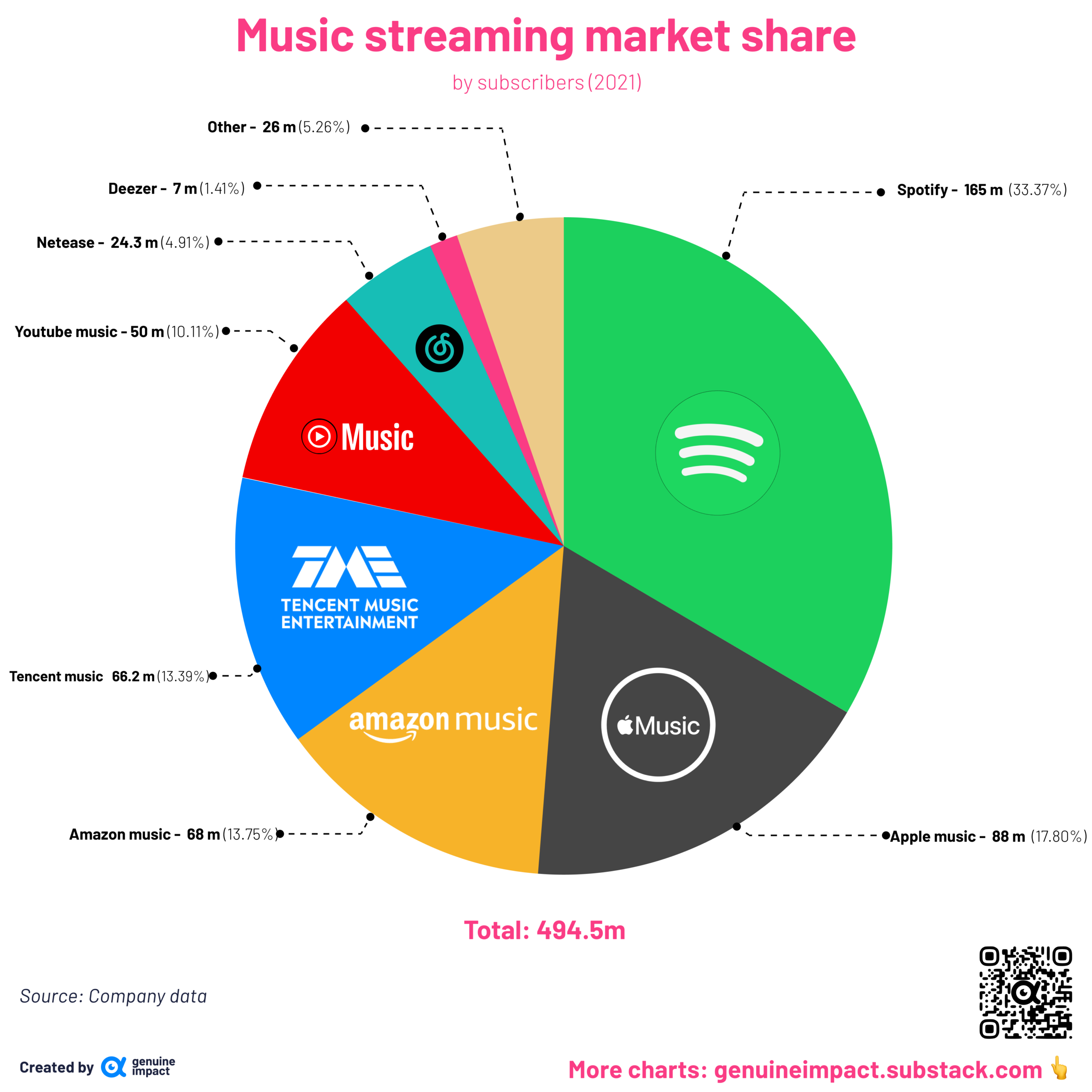
Spotify officially launched in Nigeria in February 2021 as part of a large multi-market expansion that opened dozens of African territories at once. Apple Music had arrived years earlier through its global rollout but accelerated its African investment around the same period, with editorial playlists, regional curation hires, and direct artist programmes. YouTube Music, bundled into the broader YouTube ecosystem where Nigerian music videos had been racking up billions of views for years, completed the trio of major Western platforms.
Ad SpaceIn-Article - 300x250
Advertisement
The per-stream economics shifted considerably with this group. None of the major platforms publish a per-stream rate, because none of them pay one. Royalties are calculated from a pool of subscription and advertising revenue divided by total plays, so the effective rate moves with territory, listener type, and the rights split behind each recording. Spotify’s own transparency reporting sets out aggregate payouts rather than a rate per play, and the figures that circulate are averages reverse-engineered from royalty statements. Apple Music has been widely reported to sit at the more generous end of the majors on a per-play basis, while YouTube Music occupies a complicated middle ground because its payouts blend subscriber royalties with advertising revenue from the free tier.
For a Nigerian artist, the practical implication was a trade-off rather than a single number. The audience reachable on Boomplay was larger and growing faster. The audience on the Western subscription platforms was smaller but worth multiples more per listener, because those listeners sat in territories with higher subscription prices and higher advertising rates. Building a sustainable career meant winning on both, which is why release strategies in Lagos are now planned platform by platform rather than as a single upload.
The New Math: What Top Artists Actually Earn
The visible tier of Nigerian music, the Burna Boy, Davido, Wizkid, Rema, Tems, Asake tier, now operates on numbers that would have been unimaginable in the Alaba era. Catalogues that clear billions of cumulative plays, albums that chart in the United States and the United Kingdom, and singles that sit on global playlists for months at a time have moved these artists into a bracket where streaming alone is a serious annual income rather than pocket change. Precise earnings, though, are guesswork. None of these artists publish royalty statements, no platform publishes a per-stream rate, and the estimates that appear in blogs and rich lists are built by multiplying public stream counts by assumed rates and then ignoring the label, publisher, producer, and feature splits that sit between the gross and the artist. Readers should treat any specific annual earnings figure attached to a Nigerian artist as an unsourced estimate. The direction of travel is the verifiable part, and the direction is steeply upward.
The Middle Tier
Below the global stars sits a much larger group of artists, the BNXN, Fireboy, Joeboy, Omah Lay, Pheelz, Bloody Civilian, Llona, and dozens of others, for whom streaming is a real but volatile income line rather than a stable salary. The spread within that group is enormous, and it swings on which releases connect, whether a song catches on TikTok, how recently the artist toured, and how their rights are structured between label, distributor, publisher, and producer. Two artists with similar monthly listener counts can take home very different amounts, which is why managers in this tier spend more time on contract structure than on playlist pitching.
For an independent Nigerian artist with a distributor like DistroKid, TuneCore, or AWAL, the payout flows almost directly from the platform to the artist’s account, minus the distributor’s small fee. For a signed artist, the label takes its share first, recoupment is applied against advances and marketing costs, and the artist sees what remains. The structure matters enormously to the take-home figure.
The Major Label Inflection Point
Universal Music Group’s acquisition of a majority stake in Don Jazzy’s Mavin Global in early 2024, a transaction whose price the parties did not disclose but which trade and business outlets reported in the region of $200 million, marked the loudest single signal that global capital had decided Nigerian music was no longer a frontier market. Sony and Warner had already inked partnership and distribution deals with Nigerian labels and artists over the preceding years, including Warner Music’s acquisition of a majority stake in Africori, the South African distributor that handles much of the continent’s catalogue, and a run of label-services and distribution agreements with Nigerian independents.
The Mavin number stood out because it valued a Nigerian label at a level previously reserved for established Western catalogues. The deal effectively repriced what a Nigerian music asset is worth and gave other label founders a benchmark to point to in their own negotiations.
Brand Deals and the Real Money
For the top tier of Nigerian artists, streaming income has been quietly eclipsed by brand endorsement income. Davido has fronted campaigns for spirits, telecoms, and beverage brands, Wizkid has held long-running spirits and lifestyle partnerships, Burna Boy has worked with Hennessy and a rotation of luxury houses, and the current generation of female stars has moved into the same ambassador bracket with beverage and beauty brands. Individual fees are not disclosed and the totals quoted in entertainment media are rumour rather than record, but the structural point is not in dispute among the managers who negotiate them. An ambassador contract pays a guaranteed sum on signature, regardless of how the next single performs, which is exactly the kind of certainty a royalty statement never offers. Streaming pays the rent. Brand deals buy the house.
Touring, TikTok, and the Post-Pandemic Surge
Live performance revenue has done something extraordinary since 2022. Burna Boy’s Madison Square Garden sell-out in 2022 and his subsequent stadium shows in London, Wizkid’s “Made in Lagos” run, Davido’s “Timeless” dates, and Asake’s headline tours moved Nigerian acts from support slots and diaspora community halls into arenas and stadiums inside a single touring cycle. Guarantees are not published, but the venue sizes are a matter of public record, and arena and stadium capacity is the closest thing to a verifiable earnings signal the live business offers. Festival billing has climbed in parallel, with Afrobeats acts moving up the posters at major European and North American festivals.
TikTok’s revenue contribution is more complicated. Its licensing has been built around negotiated lump-sum arrangements with rights holders rather than per-use micropayments, a structure some Nigerian labels and publishers welcome as cleaner accounting and others criticise as undervaluing the catalogue. The viral moment a TikTok hit creates still translates into streaming spikes on Spotify, Apple Music, and Boomplay, so the platform remains essential to a release plan even when its direct payout is modest.
The Piracy Problem That Never Fully Left
For all the structural progress, piracy has not vanished from the Nigerian music economy. It has migrated. The bootleg CD stalls of Alaba have shrunk, but Telegram channels distributing fresh albums hours after release, YouTube rips, and unauthorised mixtape sites continue to siphon meaningful play counts from older catalogues in particular. The artists whose careers predate the streaming era often see their classic albums circulated freely across unauthorised platforms while their newer releases benefit from the cleaner DSP infrastructure. The asymmetry quietly punishes legacy acts.
From the Alaba Marketer to the Split Sheet
Walk into one of the working studios in Lekki or Ikeja today and the receipt rack tells the new economic story without anyone having to narrate it. Distribution agreements with Empire, Sony’s The Orchard, Africori, or independent setups sit next to brand contract drafts, tour routing sheets, and Boomplay analytics dashboards open on a laptop. The producer in the corner is checking his Spotify for Artists app on his phone, watching the previous night’s release climb hour by hour. A copy of the artist’s split sheet, the document that defines who owns what percentage of which song, sits on the console where, two decades ago, a stack of master CDs would have been waiting for the Alaba marketer to pick up. Nobody is driving to Ojo with the masters. The masters are uploaded, and the cheques, smaller per unit and far more numerous, are already on their way.
Ad SpaceIn-Article - 300x250
Advertisement
Share
Get the recap
Loved this story? Get more like it.
Join readers who get our weekly entertainment recap - the stories worth your time, delivered every Friday.
No spam. Unsubscribe anytime. By signing up you agree to our Privacy Policy.