
Table of Contents
- Why Understanding the TikTok Algorithm Matters
- The TikTok Ownership Shift and What It Means for the Algorithm
- How the For You Page Actually Works
- Interest Signals: What TikTok Tracks About Your Videos
- Account Signals vs Content Signals
- Content Categories and How TikTok Classifies Videos
- Why Some Videos Go Viral Days or Weeks Later
- Hashtag Strategy: What Actually Works in 2026
- Optimal Posting Times and Frequency
- The Batch Test System for Consistent Growth
- Common TikTok Algorithm Myths Debunked
- What Changed in 2025-2026
- Key Takeaways
- Frequently Asked Questions
Why Understanding the TikTok Algorithm Matters
TikTok is the only major social media platform where a brand new account with zero followers can reach millions of people with a single video. That is not hyperbole – it is a direct result of how the TikTok algorithm works. Unlike Instagram or YouTube, where your existing audience largely determines who sees your content, TikTok evaluates every single video independently and distributes it based on its own merit. This means understanding how does the TikTok algorithm work is not optional for anyone serious about growing on the platform. It is the foundation of every successful TikTok strategy.
TikTok now has nearly 2 billion monthly active users globally as of 2026, and the average user spends approximately 98 minutes per day on the app worldwide. In the United States alone, the average adult spends around 54 minutes daily on TikTok, while younger users aged 18 to 25 average over 2.5 hours per day. That is more time than people spend on Instagram, YouTube, and X combined. The reason people stay so long is the algorithm – it is astonishingly good at predicting what each individual user wants to see next. For creators, this means the algorithm is both your biggest opportunity and your most important audience. If you understand what it rewards, you can work with it. If you ignore it, your content will struggle no matter how good it is.
This guide breaks down everything we know about how the TikTok algorithm works in 2026, based on TikTok’s own disclosures, independent research, and the observed patterns of thousands of creators. We will cover the mechanics of the For You Page, the specific signals TikTok tracks, the strategies that actually drive growth, the myths that waste creators’ time, and the major structural changes that came with TikTok’s US ownership transition.
The TikTok Ownership Shift and What It Means for the Algorithm
Before diving into the mechanics, it is important to address the biggest structural change to TikTok in its history. In January 2026, TikTok’s US operations were officially divested into TikTok USDS, a newly incorporated American-majority entity. The deal, signed in December 2025, transferred US operations to a consortium including Oracle (15%), Silver Lake (15%), and MGX (15%), with 30.1% held by existing ByteDance investors and 19.9% retained by ByteDance. A seven-member majority-American board of directors governs the entity, and the federal ban that had loomed over the app was permanently averted.
For creators, the most important consequence is that the US algorithm is being retrained on US-only data hosted on Oracle’s cloud infrastructure. ByteDance licenses its recommendation technology to TikTok USDS but is restricted from directly influencing the US content feed. In practical terms, this means the algorithm powering the American For You Page is becoming increasingly distinct from the version serving users in other countries. Regional and language-based content matching has become more refined, and going viral globally from a US-based account is slightly harder than it was in earlier years because distribution is more segmented by market.
This ownership transition does not change the fundamental principles of how the algorithm evaluates content – engagement signals, watch time, and content quality still drive distribution. But it adds a new layer of regional specificity that creators targeting US audiences should understand.
How the For You Page Actually Works
The For You Page (FYP) is TikTok’s main feed – the infinite scroll of videos that users see when they open the app. Unlike a follower-based feed (which shows content from people you follow), the FYP is algorithmically curated for each individual user based on their behavior, interests, and engagement patterns. Roughly 80-90% of TikTok content consumption happens on the FYP rather than the Following feed, which is why landing on the FYP is essential for growth.
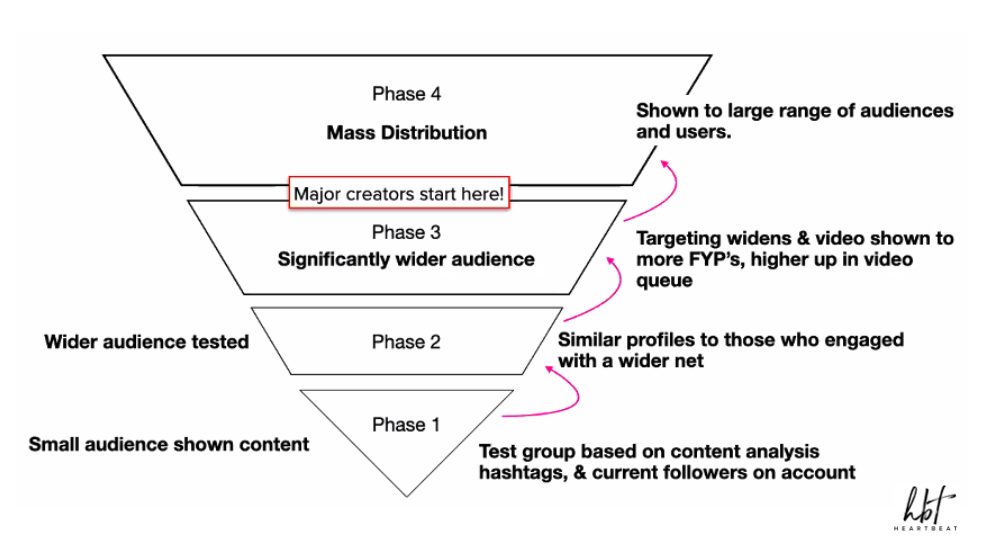
When you publish a video, TikTok does not immediately show it to millions of people. Instead, it goes through a phased distribution process. One of the biggest algorithm changes in 2026 is that new videos are now primarily shown to your existing followers first during the initial test phase, rather than a random sample. This represents a fundamental shift – your video shows to a small test audience of your followers first, and if it performs well with them, it goes wider to non-followers. The initial test group is typically 200-500 users. TikTok uses computer vision, natural language processing, and audio recognition to understand what your video is about before showing it to anyone.
Based on how that initial test audience responds, TikTok decides whether to push your video to a larger group. If the first 200-500 viewers watch most of your video, like it, share it, comment on it, or save it, TikTok interprets that as a positive signal and shows it to 1,000-5,000 more users. If that larger group also responds positively, distribution expands to 10,000-50,000, then 100,000+, and potentially millions. At each stage, the algorithm is evaluating whether the video deserves a wider audience based on real engagement data.
This phased approach still makes TikTok fundamentally different from other platforms. On YouTube, a video’s initial performance is heavily influenced by how many subscribers see and click on it. On Instagram, reach is largely determined by your follower count and engagement rate. On TikTok, every video gets a test, and the content determines the outcome. A video from an account with 3 followers is evaluated by the same system as a video from an account with 3 million followers. The shift to follower-first testing means building an engaged follower base matters more than it used to, but the core principle remains: quality content can break through regardless of account size.
Interest Signals: What TikTok Tracks About Your Videos
Understanding how does the TikTok algorithm work requires knowing exactly which signals the platform uses to evaluate your content. TikTok has confirmed several categories of signals, and independent research has identified others. Here are the most important ones, ranked by their apparent weight in the 2026 algorithm.
Watch Time and Completion Rate
This is the single most important signal, and it has become even more critical in 2026. The completion rate bar for viral distribution is now approximately 70% – up from around 50% in 2024. If someone watches your entire video, that tells TikTok the content is engaging. If they watch it twice (a replay), that is an even stronger signal. If they scroll away after 2 seconds, the algorithm takes note. Average watch time as a percentage of total video length is the metric that matters most. A 15-second video where the average viewer watches 13 seconds (87% completion) will dramatically outperform a 60-second video where the average viewer watches 20 seconds (33% completion), even though the longer video technically has more total watch time per view.
This is why shorter videos are generally easier to make go viral – it is easier to hold attention for 15 seconds than for 60 seconds. However, TikTok has increasingly rewarded longer content (1-3 minutes and even up to 10 minutes) that maintains high retention. A 3-minute video with 70% average completion signals extremely engaging content and will be pushed aggressively by the algorithm. The 2026 algorithm specifically prioritizes watch time over raw views, meaning a video that keeps people watching is valued more than one that gets lots of quick impressions.
Shares
Shares are the second most valuable engagement signal and carry even more weight in 2026 than they did previously. When someone shares your video to a friend via direct message, to another platform, or to their own story, it tells TikTok that the content was compelling enough for the viewer to actively recommend it. Shares carry more algorithmic weight than likes or comments because they require more effort and represent a stronger endorsement. Videos that generate high share rates tend to be emotionally resonant, practically useful, or surprisingly entertaining.
Comments and Comment Quality
Comments signal that your video sparked a reaction strong enough for someone to type a response. A significant 2026 change is that comment quality now matters more than comment count. The algorithm evaluates the depth and substance of comments – substantive questions, detailed reactions, and genuine discussion carry more weight than simple emoji replies or single-word responses. Videos that generate meaningful debates, detailed questions, or thoughtful emotional responses in the comments tend to receive extended distribution. This is why many successful TikTok creators intentionally include slightly controversial opinions, open-ended questions, or minor “mistakes” that prompt viewers to leave detailed comments.
Saves
Saves (bookmarks) are more valuable than likes because they indicate the viewer found the content useful enough to return to later. Saves are now weighted alongside shares as a top-tier engagement signal. Educational content, tutorials, recipes, and informational videos tend to generate high save rates. If you can create content that viewers want to reference again, your save rate will push your distribution significantly.
Likes and Profile Visits
Likes are the most common engagement action but carry the least individual weight because they require minimal effort. However, a high like-to-view ratio still matters. Profile visits and follows after watching signal strong interest and tell TikTok that your content made a lasting impression. Videos that drive profile visits typically have a strong personality hook – they make the viewer curious about who created them.
Account Signals vs Content Signals
TikTok evaluates both your account overall and each individual piece of content. Understanding the difference helps explain why some accounts grow consistently while others have one viral video and then stagnate.
Account signals include your overall engagement rate, your posting consistency, your follower growth trajectory, and the niche coherence of your content. An account that posts regularly, maintains consistent engagement, and stays focused on a specific topic area builds what creators call “account authority” – the algorithm learns what kind of audience your content serves and becomes better at distributing it to the right people. With the 2026 shift to follower-first testing, account authority matters more than ever – your followers are now your first test audience, so having engaged followers who actually watch your content is critical for triggering wider distribution.
Content signals are evaluated independently for each video. Even if your account has low authority, a single exceptional video can still go viral because TikTok evaluates it on its own merits with the test audience system. This is why TikTok remains the most democratic platform for new creators – your account history helps, but it never prevents a good video from performing well.
The practical takeaway is to optimize for both. Build account authority by posting consistently in a focused niche (this helps your average-performing videos reach more people). And optimize each individual video for maximum engagement (this gives your best content the chance to break through to much larger audiences).
Content Categories and How TikTok Classifies Videos
TikTok uses machine learning to automatically classify every video into content categories. This classification determines which interest pools your video is shown to during the initial test phase. The more accurately TikTok can categorize your content, the more relevant your test audience will be, and the more likely your video is to perform well.
TikTok classifies content using multiple inputs. Visual analysis identifies objects, scenes, activities, and people in your video. Audio analysis recognizes music tracks, speech content, and sound effects. Text analysis processes on-screen text, captions, and your video description. Hashtag analysis categorizes your content based on the hashtags you use. User behavior patterns connect your content to similar videos that the same users have engaged with.
For creators, this means clarity is important. A cooking video with a clear shot of food preparation, a cooking-related sound, relevant text overlay (“Easy 10-minute pasta recipe”), and cooking hashtags will be accurately classified and shown to users who love cooking content. A vague video with unclear visuals, no text, random music, and generic hashtags will confuse the classification system and be shown to a less relevant audience, resulting in worse performance.
This is also why niche consistency matters so much. When you post cooking content consistently, TikTok becomes increasingly confident in classifying your videos and increasingly effective at finding the right audience for them. The 2026 algorithm specifically rewards niche-specific content over broad, unfocused posts. Data shows that creators who stay within a defined niche see better distribution than those who alternate between wildly different topics.
Why Some Videos Go Viral Days or Weeks Later
One of the most frequently asked questions about how does the TikTok algorithm work is why some videos seem to go viral days, weeks, or even months after being posted. This phenomenon – sometimes called “delayed virality” or “the TikTok time bomb” – happens because of how the phased distribution system interacts with changing user behavior and algorithmic re-evaluation.
When you post a video, it enters the initial test phase and either gains traction or does not. If it does not gain immediate traction, TikTok does not permanently shelve it. Instead, the video remains in a pool of content that can be re-surfaced at any time. The algorithm periodically re-tests older content, especially when it detects shifts in user interest patterns. For example, if a trending topic emerges that relates to a video you posted three weeks ago, TikTok may re-introduce your video to new test audiences because it is now more relevant.
Delayed virality also happens when a video’s engagement metrics cross certain thresholds over time rather than immediately. A video might get 50 views on day one, 200 on day three (because a few of those initial viewers shared it), 1,000 on day five, and 100,000 on day seven as the cascading engagement hits each algorithmic distribution level. The timeline is not always linear, and TikTok’s distribution system operates on its own schedule rather than strictly on posting time.
For creators, the practical lesson is to never delete a video that did not perform well immediately. Videos can resurface at any time, and deleting them permanently removes that possibility. Some of the most viral TikTok videos in history had modest performance for days or weeks before suddenly exploding. Patience and a long-term perspective are essential for anyone serious about growing on TikTok.
Hashtag Strategy: What Actually Works in 2026
Hashtag strategy on TikTok has evolved significantly. The outdated advice of using #fyp, #foryou, and #foryoupage in every post no longer provides any meaningful benefit – TikTok has confirmed that these generic hashtags do not influence whether your video appears on the For You Page. Here is what actually works in 2026.
Use 3-5 specific, relevant hashtags per video. Each hashtag should serve one of two purposes: either categorizing your content for the algorithm (helping TikTok understand what your video is about) or connecting your content to an active community of users who follow that hashtag. A cooking creator might use #easyrecipes, #weeknightdinners, and #cookingforbeginners – specific enough to reach the right audience but broad enough to have substantial search volume.
Mix hashtag sizes. Include one or two larger hashtags (1-10 billion views) for broad discovery and two or three smaller hashtags (1-100 million views) for targeted reach. Smaller hashtags have less competition, meaning your video is more likely to appear at the top of that hashtag’s feed. Larger hashtags have more users browsing them but also more competition. The combination gives you both targeted and broad exposure.
Use trending hashtags when they genuinely relate to your content. TikTok regularly promotes hashtag challenges and trending topics that receive extra algorithmic boost. If a trending hashtag aligns with your niche, incorporating it can significantly increase your video’s initial distribution. But forcing a trending hashtag onto unrelated content will hurt performance because the audience it attracts will not engage with content that does not match their expectations.
Research hashtags using TikTok’s search function. Type your topic into the search bar and look at the “Hashtags” tab to see related hashtags along with their total view counts. Also check the “Top” and “Videos” tabs to see what kind of content is currently performing well under those hashtags. This research takes 5-10 minutes per video and can significantly improve your targeting.
Optimal Posting Times and Frequency
While the TikTok algorithm evaluates content independently of posting time, when you post still matters because it affects your initial test audience’s behavior. With the 2026 shift to follower-first testing, posting when your followers are active has become even more important. If you post at 3 AM when most of your followers are asleep, your initial test group will be less engaged, producing weaker signals that limit further distribution.
General data from multiple studies suggests the best times to post on TikTok are between 7-9 AM, 12-1 PM, and 7-11 PM in your target audience’s primary time zone. These windows correspond to morning scrolling, lunch breaks, and evening relaxation – the three peak usage periods for most demographics. However, these are averages, and your specific audience may behave differently.
The best way to find your optimal posting times is to use TikTok’s built-in analytics (available on Creator or Business accounts). Go to your Analytics dashboard, check the “Followers” tab, and look at the “Follower Activity” section, which shows you exactly when your followers are most active on the app. Post during those peak activity windows for the best chance of strong initial engagement.
Regarding posting frequency, more is generally better on TikTok – up to a point. Posting 1-3 times per day gives you multiple shots at reaching new audiences each day. Posting once per day is sufficient for steady growth. Posting 3-5 times per week is the minimum for maintaining algorithmic momentum. Posting less than 3 times per week makes it difficult to build consistent traction because the algorithm favors active accounts. Quality should never be sacrificed for quantity, but if you have the capacity to post daily, the data supports doing so.
The Batch Test System for Consistent Growth
The “batch test” system is a growth strategy used by many successful TikTok creators that works directly with how the TikTok algorithm distributes content. The concept is simple: instead of posting one video and hoping it goes viral, you create batches of 5-10 videos around the same topic or format, post them over several days, and analyze which ones the algorithm favors.
Here is how it works in practice. Choose a content theme or format – for example, “surprising facts about common foods.” Create 7 videos in this format, each covering a different food fact. Post them over the course of a week, one per day. Track the performance of each video: views, completion rate, shares, and comments. Out of those 7 videos, 1-2 will likely significantly outperform the others. Analyze what made those top performers different – was it the hook, the specific topic, the pacing, the visual style, the sound choice?
Then create your next batch of 7 videos incorporating the lessons from the first batch. Double down on what worked and drop what did not. Over time, this iterative testing process refines your understanding of what your specific audience responds to and what the algorithm rewards for your particular niche. Most successful TikTok creators go through 3-5 batch cycles before finding a consistent formula that reliably generates strong views.
The batch test system also helps psychologically. Instead of pinning all your hopes on a single video (and feeling crushed when it does not go viral), you treat each batch as an experiment. Not every video needs to be a hit – you just need to learn something from each one. This mindset reduces creative burnout and keeps you focused on long-term improvement rather than short-term results.
Common TikTok Algorithm Myths Debunked
Misinformation about the TikTok algorithm is rampant. Here are the most common myths and the reality behind them.
Myth: Using #fyp and #foryoupage gets you on the For You Page. Reality: TikTok has explicitly stated that no hashtag guarantees placement on the FYP. The For You Page is determined by engagement signals, not hashtags. Using these generic hashtags wastes hashtag slots that could be used for relevant, targeted hashtags that actually help the algorithm categorize your content.
Myth: The algorithm suppresses your reach if you post too often. Reality: There is no evidence that posting frequently hurts your reach. Each video is evaluated independently. However, if posting too often leads to lower quality content that gets poor engagement, those weak-performing videos can affect your account signals over time. The issue is quality, not frequency.
Myth: Editing your caption or hashtags after posting kills the video’s reach. Reality: TikTok allows editing captions within a short window after posting. While there is anecdotal evidence that major edits during peak distribution might temporarily affect a video’s momentum, minor caption edits (fixing a typo, adjusting a hashtag) do not meaningfully impact performance.
Myth: The algorithm penalizes you for deleting videos. Reality: Deleting underperforming videos does not negatively impact your account or your other videos’ performance. However, as mentioned earlier, there is no benefit to deleting them either – older videos can resurface at any time, so keeping them gives you additional chances at delayed virality.
Myth: You need to go viral to grow on TikTok. Reality: Consistent, moderate performance is a more reliable growth path than chasing virality. An account that averages 5,000-10,000 views per video and posts daily will grow faster and more sustainably than an account that gets one video with 1 million views and then returns to 200 views per video. Virality is a bonus, not a strategy.
What Changed in 2025-2026
The TikTok algorithm is not static – it evolves continuously based on platform priorities, user behavior changes, competitive pressure from Instagram Reels and YouTube Shorts, and now the US ownership transition. Here are the most significant changes creators should be aware of in 2025-2026.
Follower-first testing is the biggest algorithmic shift. New videos are now primarily shown to existing followers during the first few days before being pushed to wider audiences. This is the most fundamental change to how the algorithm distributes content. It means building and maintaining an engaged follower base is more important than ever. Creators who relied on the old model of reaching entirely new audiences with each post need to adjust their strategy to nurture their existing community.
The completion rate bar has risen significantly. The threshold for viral distribution has climbed to approximately 70% average completion rate, up from around 50% in 2024. This means videos need to hold attention more effectively than before. Hook quality, pacing, and storytelling structure are more critical than ever. Videos that lose viewers in the first few seconds face a steeper uphill battle.
Authenticity beats production value. Behind-the-scenes content, talking-head videos, and “raw” content styles now see 31% higher engagement than heavily edited, production-heavy videos. TikTok’s algorithm actively down-ranks low-effort reposts, watermark-heavy content, and videos that appear mass-produced. The platform is prioritizing authentic human creators over AI-generated content, with disclosure requirements and distribution limitations for videos identified as AI-generated.
Search-based discovery is increasingly important. TikTok has invested heavily in its search functionality, and a growing percentage of video discovery now happens through search rather than passive FYP scrolling. Optimizing your captions, on-screen text, and spoken content for searchable keywords now directly impacts your video’s discoverability. Think of it as SEO for TikTok – if someone searches “best budget camera 2026” and your video covers that topic with those words in the caption, it is more likely to appear in search results.
Photo carousels and series content are gaining algorithmic support. TikTok has been promoting photo carousel posts with extra distribution. Series content – multi-part videos that encourage viewers to follow for the next installment – also receives favorable treatment because it drives follower growth and return visits, both of which TikTok values.
The US algorithm is being retrained on domestic data. Following the January 2026 divestiture, the US recommendation engine is running on Oracle’s cloud infrastructure and being retrained on US-only data. This means the American For You Page is becoming more distinct from international versions. Creators targeting US audiences should expect more refined regional matching, while creators seeking global reach may need to adjust their approach for different markets.
TikTok Shop integration affects content distribution. TikTok Shop has expanded significantly, and commerce-related content receives its own distribution pathways. Product review videos, shopping haul content, and TikTok Shop livestreams are evaluated with additional commerce-specific signals including product interaction diversity and purchase conversion rates. Creators who integrate shopping features may see distribution benefits within commerce-oriented feeds.
Key Takeaways
- Watch time completion rate is the single most important signal – the viral threshold has risen to approximately 70% in 2026, up from 50% in 2024.
- The 2026 algorithm now shows new videos to your followers first before testing with wider audiences, making an engaged follower base more important than ever.
- Shares and saves carry more algorithmic weight than likes or comments, and comment quality (depth, substance) now matters more than comment count.
- Generic hashtags like #fyp do nothing – use 3-5 specific, relevant hashtags that help the algorithm categorize your content.
- Niche consistency builds “account authority” that improves distribution for all your videos over time.
- Videos can go viral days or weeks after posting – never delete underperforming content.
- Authenticity wins – raw, human-created content sees 31% higher engagement than heavily produced or AI-generated videos.
- The batch test system (creating 5-10 similar videos, analyzing performance, and iterating) is the most reliable growth strategy.
- TikTok’s US operations are now under American-majority ownership with the algorithm running on Oracle’s cloud, creating a more regionally distinct experience.
- Search optimization matters – TikTok search is growing as a discovery channel, so include searchable keywords in captions and on-screen text.
Frequently Asked Questions
How does the TikTok algorithm decide what to show on the For You Page?
The TikTok algorithm evaluates each video based on engagement signals, starting with a test among your existing followers (a key 2026 change). The primary signals are watch time completion rate (now requiring approximately 70% for viral distribution), shares, saves, comment quality, and likes. If the test audience engages positively, the video is shown to progressively larger groups. The algorithm also considers your account’s posting history, niche consistency, and the content’s relevance to each user’s individual interest profile. No single factor determines FYP placement – it is the combination of all these signals.
Does the time I post on TikTok affect my video’s performance?
Posting time affects the quality of your initial test audience, which indirectly impacts performance. With the 2026 follower-first testing model, posting when your followers are most active (typically 7-9 AM, 12-1 PM, or 7-11 PM in their time zone) is more important than before. Check your TikTok Analytics under the Followers tab to see exactly when your specific followers are most active, and prioritize those windows.
Is TikTok still available in the United States after the ban concerns?
Yes. TikTok’s US operations were successfully divested into TikTok USDS, an American-majority entity, in January 2026. The deal involved Oracle, Silver Lake, MGX, and existing ByteDance investors, with a majority-American board of directors. The federal ban was permanently averted. The app continues to operate with nearly 170 million American users, though the US algorithm is now running on Oracle’s cloud infrastructure separately from ByteDance’s international systems.
How many hashtags should I use on TikTok?
Use 3-5 specific, relevant hashtags per video. Include a mix of larger hashtags (1-10 billion views) for broad discovery and smaller hashtags (1-100 million views) for targeted reach. Avoid generic hashtags like #fyp, #viral, or #foryou – they do not influence algorithmic distribution and waste space that could be used for hashtags that help TikTok understand and categorize your content. Research hashtags using TikTok’s search function before each post.
Can a TikTok video go viral after being posted for weeks?
Yes. Delayed virality is a well-documented phenomenon on TikTok. The algorithm periodically re-tests older content with new audiences, especially when trending topics align with your video’s subject matter. Videos have gone viral weeks and even months after being posted. This is why you should never delete videos that did not perform well initially – they can always resurface. Keep all your content published and focus on creating new videos rather than obsessing over past performance.