
Table of Contents
- Starting From Zero Is Normal
- The Standard Acting Resume Format
- What to Include When You Have No Credits
- Making Your Training Section Count
- Special Skills That Actually Matter
- How to Get Your First Credits Fast
- Free Acting Resume Template
- Formatting and Technical Tips
- Mistakes to Avoid on a Beginner Resume
- Key Takeaways
- Frequently Asked Questions
Starting From Zero Is Normal
Every actor in history – from Meryl Streep to Timothee Chalamet – had a moment when their acting resume was completely blank. If you are Googling “how to build an acting resume with no experience,” you are at the same starting point as every working actor once was. The difference between those who build careers and those who stay stuck is not talent or luck – it is knowing how to present yourself professionally from day one and taking strategic steps to fill that resume quickly.
Here is the encouraging reality: casting directors, agents, and acting teachers all understand that everyone starts somewhere. A well-formatted resume with limited credits but strong training signals that you are serious, professional, and worth investing time in. A messy, poorly formatted resume – even one with more credits – suggests the opposite. When you are learning how to build an acting resume with no experience, presentation and strategy matter more than volume.
This guide gives you everything you need: the exact format casting directors expect, what to include when your credits section is thin, how to get real credits quickly, and a free template you can customize immediately. By the time you finish reading, you will have a professional resume ready to submit.

The Standard Acting Resume Format
Acting resumes follow a specific format that is different from regular job resumes. Understanding this format is the first step in learning how to build an acting resume with no experience that looks professional.
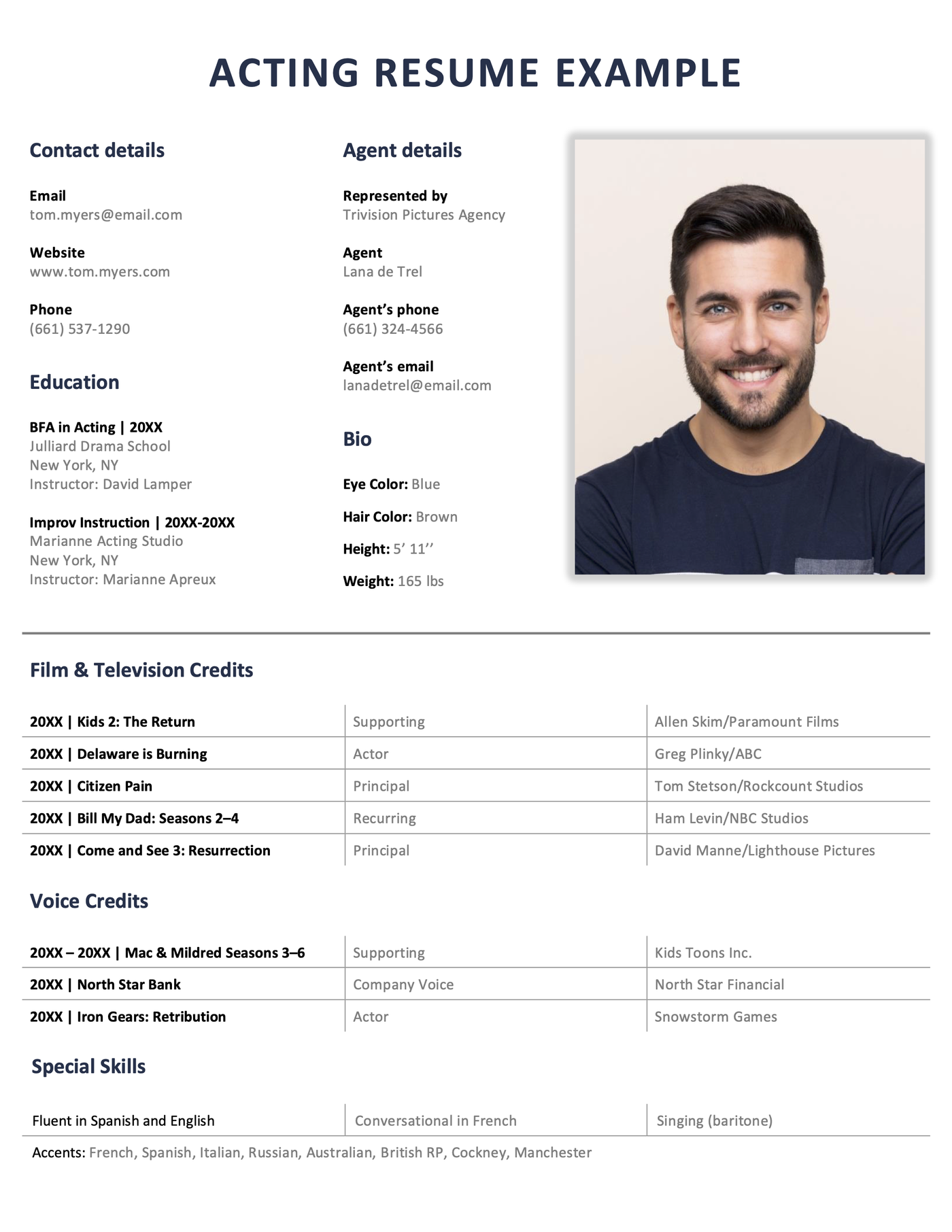
Header section: Your full name (or stage name) centered at the top in a larger font. Below that, your union affiliation (SAG-AFTRA, AEA, or Non-Union). Then your physical stats: height, weight (optional), hair color, and eye color. Finally, your contact information or your agent/manager’s contact information. If you do not have representation, list your email and phone number. Never list your home address.
Credits section: This is the main body of the resume, organized into three columns and categorized by medium. The categories are: Film, Television, Theater, New Media/Web Series, Commercials (listed as “Conflicts Available Upon Request” rather than naming specific brands), Voice-Over, and any other relevant categories. Within each category, the three columns show: Project Title | Role (Lead, Supporting, Featured, etc.) | Director or Production Company.
Training section: List your acting training in reverse chronological order. Include the technique or class name, the instructor, and the institution. For example: “Scene Study – John Smith – Atlantic Theater Company.”
Special Skills section: A list of genuine, performable skills. More on this in a dedicated section below.
Physical format: Acting resumes are printed on 8×10 paper – the same size as your headshot – and stapled to the back of the headshot so when someone flips the photo over, they see your resume. For digital submissions, upload your resume as a separate document alongside your headshot on casting platforms.
What to Include When You Have No Credits
The biggest concern when figuring out how to build an acting resume with no experience is what to put in the credits section. If you have literally zero credits, here is what you can legitimately include.
School and college productions: If you performed in high school plays, college theater productions, or school talent shows, these count. List them under Theater with the school name as the production company. “Romeo and Juliet | Romeo | Central High School Drama Dept.” is a legitimate credit.
Church and community performances: Christmas pageants, church plays, community center shows, and local event performances are all valid credits. They demonstrate that you have stood in front of an audience and delivered a performance.
Acting class showcases: Many acting classes culminate in scene showcases or presentations. These can be listed under Theater or Training. “Scene Showcase – Lead – Meisner Technique Studio” works perfectly.
Student films: If you have participated in any student film projects – even a friend’s film school assignment – list them under Film with “Student Film” noted. These are taken seriously because many successful filmmakers started with student films.
If you truly have nothing: Focus heavily on your Training and Special Skills sections. A resume with no credits but impressive training (multiple classes, reputable instructors, varied techniques) tells an agent or casting director that you are investing in your craft and will be a prepared, directable actor. This is far better than fabricating credits, which will be discovered and will destroy your credibility permanently.
Making Your Training Section Count
When your credits section is light, your training section becomes the most important part of your resume. Here is how to make it shine.
List all relevant training: Acting classes (scene study, cold reading, audition technique, on-camera technique), improv classes, voice and speech classes, dialect training, movement classes (Alexander Technique, Laban, Viewpoints), dance training, singing lessons, stage combat, and any workshops or intensive programs you have attended.
Name the instructor and institution: “Meisner Technique – Sarah Johnson – Neighborhood Playhouse” carries more weight than just “Meisner Technique.” Industry professionals recognize instructor names and training institutions, and a well-known instructor’s name on your resume can open doors.
Include ongoing training: If you are currently enrolled in a class, mark it as “Ongoing” or list the date range. Continuing education signals dedication. Many successful working actors list current training on their resumes throughout their careers.
Degrees matter: A BFA or MFA in Acting or Theater from a reputable program is a significant credential. List it prominently. Programs at schools like Juilliard, Yale Drama, NYU Tisch, Carnegie Mellon, UCSD, and other top programs carry enormous weight. But even a degree from a less well-known program demonstrates serious commitment and multi-year training.
Workshops and intensives: Weekend workshops, summer intensives, and masterclasses all count. Even a single workshop with a notable instructor is worth listing when you are building your resume from scratch.

Special Skills That Actually Matter
The special skills section is often undervalued by new actors, but it is actually one of the most-read sections on a resume – especially for actors with limited credits. Casting directors scan special skills to find actors with specific abilities needed for roles.
Skills that get you cast:
Languages and dialects: Fluency in any language or proficiency in specific accents (British RP, Southern American, Brooklyn, Irish) is incredibly valuable. Bilingual actors are in high demand. List the language and your proficiency level honestly.
Musical instruments: If you play guitar, piano, drums, violin, or any other instrument at a performable level, list it. Musical ability opens doors to roles in musicals, music-themed projects, and scenes that require a character to play an instrument.
Athletic abilities: Martial arts (specify style and belt level), gymnastics, horseback riding, swimming, fencing, rock climbing, skateboarding, surfing, boxing, and other sports. These come up in action scenes, period pieces, and sports-themed projects constantly.
Performance skills: Singing (specify range – soprano, tenor, baritone), dance (specify styles – ballet, jazz, hip-hop, ballroom, tap), stand-up comedy, improv, magic, juggling, and puppetry.
Practical skills: Valid driver’s license (including motorcycle or commercial vehicles), firearms proficiency, medical training (CPR, EMT), cooking (professional level), bartending, and any trade skills like carpentry or welding that might be needed for character authenticity.
What NOT to list: Do not list subjective qualities like “crying on cue,” “good listener,” or “fast learner.” Do not list skills you cannot demonstrate on the spot if asked. A casting director who sees “fluent in French” on your resume may test you in the room. If you took two years of high school French and cannot hold a conversation, do not claim fluency – list “conversational French” instead.
How to Get Your First Credits Fast
The fastest way to transform your answer to “how to build an acting resume with no experience” from theoretical to practical is to start getting real credits. Here are the most accessible paths for beginners.
Student films: Film schools at universities constantly need actors for student projects. These roles are almost always unpaid but provide real on-camera experience, footage for your reel, and a legitimate credit. Contact the film department at your nearest university and ask to be added to their casting list. Websites like Backstage, Actors Access, and even Craigslist list student film auditions regularly.
Community theater: As we covered in our guide on starting community theater, these organizations welcome actors at all experience levels. A community theater credit shows you can learn lines, take direction, perform in front of an audience, and work collaboratively – all things casting directors care about.
Independent and short films: Independent filmmakers frequently cast through Backstage, Actors Access, and social media. These projects range from zero-budget passion projects to well-funded shorts with festival aspirations. Even unpaid roles on quality independent projects provide credits, footage, and connections.
Web series: The web series world is a thriving ecosystem for new actors. Many web series are created specifically to provide opportunities for emerging talent. Some web series have even led to professional careers – Issa Rae’s “Awkward Black Girl” web series led to her HBO deal for “Insecure.”
Background and extra work: Working as a background performer (extra) on professional film and TV sets provides valuable on-set experience and helps you understand how productions work. However, background work is NOT listed on an acting resume – it is considered a separate category from acting. The experience is valuable, but the credits do not go on your resume.
Free Acting Resume Template
Here is a template you can copy and customize immediately. Replace the bracketed information with your own details.
[YOUR FULL NAME]
[Union Status: SAG-AFTRA / Non-Union] | Height: [X’X”] | Hair: [Color] | Eyes: [Color]
[Email] | [Phone] | [Agent Name and Agency if applicable]
FILM
[Project Title] | [Role Type – Lead/Supporting/Featured] | [Director Name] (Student Film/Short/Feature)
TELEVISION
[Project Title] | [Role Type] | [Network/Platform] | [Director Name]
THEATER
[Production Title] | [Character Name] | [Theater Company/Venue] | [Director Name]
NEW MEDIA / WEB SERIES
[Project Title] | [Role Type] | [Platform/Producer] | [Director Name]
COMMERCIALS
Conflicts Available Upon Request
TRAINING
[Class/Technique] | [Instructor Name] | [Institution]
[Degree, if applicable] | [Major] | [University Name]
SPECIAL SKILLS
[List skills separated by commas: Languages, dialects, instruments, sports, dance styles, certifications, etc.]
Formatting and Technical Tips
Professional formatting makes the difference between a resume that gets read and one that gets skipped. Follow these technical guidelines precisely.
Font: Use a clean, readable font. Times New Roman, Arial, Calibri, and Garamond are all safe choices. Your name should be in a larger size (14 to 18 point). Body text should be 10 to 11 point. Do not use decorative or unusual fonts – they distract from the content and can appear unprofessional.
One page only: Acting resumes are always one page. Always. Even actors with decades of credits edit their resume to fit one page by removing older or less significant credits. As a beginner, fitting everything on one page will not be your challenge – but spacing everything properly so it does not look empty is. Use consistent margins and spacing to fill the page without looking stretched.
Alignment: Use consistent column alignment. The three-column format (Project | Role | Director/Production) should have clear, evenly spaced columns. Tab stops or table formatting in your word processor will help you achieve clean alignment.
Digital versus print: For online submissions, save your resume as a PDF to preserve formatting across different devices and operating systems. For in-person auditions, print on 8×10 paper and staple it to the back of your headshot – one staple in each corner is standard.
Mistakes to Avoid on a Beginner Resume
When learning how to build an acting resume with no experience, knowing what NOT to do is just as important as knowing what to do.
Never fabricate credits. The entertainment industry is smaller than you think. Casting directors, agents, and other actors know each other. If you claim to have been in a production that you were not in, someone will notice. IMDb, social media, and simple Google searches make verification easy. One fabricated credit can permanently damage your reputation.
Do not list background or extra work as acting credits. Being an extra on a major film set is a great learning experience, but listing “Extra – Marvel Movie” on your acting resume signals that you do not understand industry norms. Background work goes on a separate document if needed, never on your acting resume.
Do not include a photo on the resume itself. Your headshot is a separate document. The resume is text only. Including a photo on the resume wastes space and looks amateur.
Do not include your age or date of birth. List your age range if relevant (e.g., “plays 25-35”), but never your actual age. Casting is based on what age you appear, not your real age.
Do not include an objective statement. Unlike corporate resumes, acting resumes never include objective statements, summaries, or personal descriptions. Your headshot conveys your look, your credits convey your experience, and your training conveys your commitment.
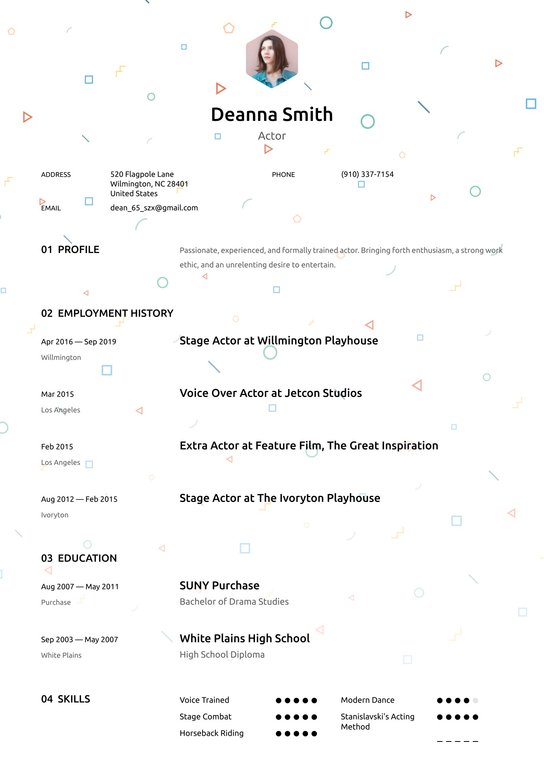
Do not use a generic resume template. Standard resume templates from Microsoft Word or Google Docs are designed for corporate resumes and will look wrong for an acting resume. Use an acting-specific format or create your own using the template provided above.
Key Takeaways
- Every actor starts with a blank resume – professional formatting and strong training credentials make a thin resume look credible, not empty.
- Follow the standard acting resume format: Name/stats at top, credits in three-column layout by medium, training, then special skills – all on one 8×10 page.
- When credits are thin, lean heavily on your training section – list every class, workshop, and instructor with specific technique names and institution names.
- Get real credits fast through student films, community theater, independent shorts, and web series – these are all legitimate resume entries.
- Never fabricate credits or list background work as acting roles – both will be discovered and will damage your reputation permanently.
Frequently Asked Questions
Should I submit a resume if I have no acting credits at all?
Yes. A well-formatted resume with strong training and relevant special skills is better than no resume. Casting directors understand that new actors need opportunities to build credits. Focus on making your training section impressive and your special skills specific and genuine. Many casting directors have given first breaks to actors whose resumes showed serious training and a professional presentation, even without credits.
Can I list high school plays on my acting resume?
Absolutely, especially when you are just starting out. List them under Theater with the school name as the production company. As you accumulate more professional credits, you will eventually replace high school credits with stronger ones. But there is no shame in starting with school productions – they demonstrate real performance experience.
How do I format my resume if I only have two or three credits?
Use generous but consistent spacing between sections, and expand your Training and Special Skills sections to fill the page. You can also add a “Related Experience” section for things like hosting, public speaking, or emcee work that demonstrates performance ability. The goal is a page that looks intentionally designed, not sparse. Never pad with fabricated credits or irrelevant information.
Should I include non-acting work experience on my acting resume?
No. Acting resumes should only contain acting credits, training, and performance-related skills. Your day job, education (unless it is an acting degree), and other professional experience belong on a standard corporate resume, not on your acting resume. The only exception might be highly relevant work – for example, if you worked as a police officer and are auditioning for cop roles, mentioning that under Special Skills could be appropriate.
How often should I update my acting resume?
Update immediately after every new credit, training program, or notable skill acquisition. Before every audition or submission, review your resume to make sure it reflects your current experience. As you add credits, remove the weakest existing entries to keep everything on one page. Your resume should always represent the strongest, most current version of your professional profile.